
Trade-in offers can feel mysteriously low compared to the sticker prices you see online.
However, dealers aren’t just low-balling you. They are making a wholesale offer to cover their margin and reconditioning costs to on-sell the vehicle.
To negotiate effectively, you must know how to find the trade in value of your car using data rather than sentiment.
In this article, we’ll share a repeatable method to estimate a realistic trade-in range,
Why Trade-In for Less?
Seeing cars like yours listed online for $30,000 but receiving a $22,000 offer may come as a shock.
There are some biases of course, that lead people to assume the best case scenario for their sale.
But the reality is that a trade-in is transacted at a wholesale figure or it is not worth the dealership’s time.
You cannot compare wholesale offers to retail advertisements.
Dealers incur significant costs to bridge that gap and transform your trade-in into a retail-ready vehicle.
The costs can go into things like:
- Reconditioning: Paint correction, new tyres, and mechanical roadworthy repairs.
- Statutory Warranty: Mandatory legal coverage for faults after the sale.
- Holding Costs: Interest and insurance paid while the car sits on the lot.
- Profit Margin: The necessary markup for the business to operate.
So the real question is whether the convenience and time saved is worth the reduced sale price you will get at a trade-in.
If the answer is yes, then your goal is to estimate a realistic wholesale price range.
Follow the steps below to establish a range of values prior to going into the dealership.
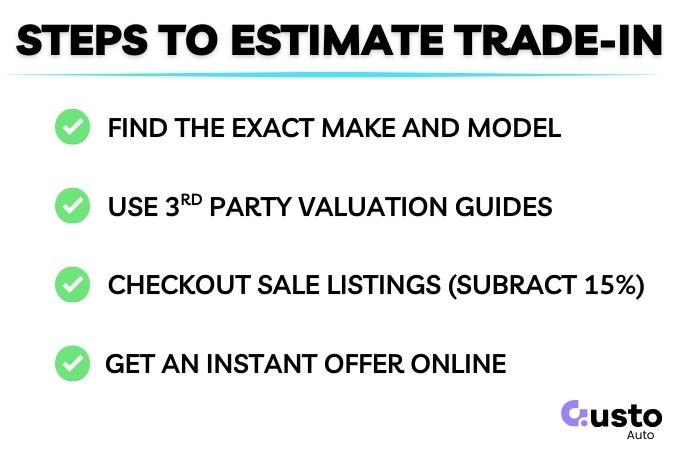
4 Steps to Determine Your Trade-in Value
1. Capture the Exact Vehicle Identity
Generic descriptions lead to defensive, low-ball offers. Dealers hedge their risk against the unknown, so you must identify the exact Series and Trim level.
For example, a 2018 Mazda CX-5 Maxx commands a significantly lower price than a top-spec Akera.
Consult your registration papers or purchase contract to confirm:
- Specs: Year, Make, Model, Series/Badge, Body, Fuel, and Transmission.
- Status: Exact odometer reading, registration expiry, and any active warning lights.
- Evidence: Service logbooks, invoices, manuals, and both keys.
Missing items like a spare key or service history can reduce a valuation by hundreds of dollars.
2. Industry Source Valuation Method
There are three easy to access data points that can help build a defensible price range before visiting a dealership.
Source A: Valuation Guides
Check RedBook or Glass’s Guide.
Ignore Retail figures and focus strictly on the Trade In Price.
Be honest about the condition of the vehicle.
Wear and tear like scratches, dents, or missed services may force you to the lower end of that bracket.
Source B: Live Markets
Scan Carsales or Gumtree for the same year, trim, and KMs.
Take the lowest comparable asking prices and deduct 10-15%.
This accounts for the asking price optimism and brings you closer to a realistic transaction value.
The prices you see are not always the price the cars are sold at.
Source C: Instant Online Offers
Get an Instant Offer quote online.
Treat this as a conditional baseline and an alternative offer to fall back on if the dealership makes a ridiculous offer.
You now have a floor for your negotiation and your price range goes from there up to the top of the valuation guides (if in immaculate condition).
Each number is now your Target Price and your Walk-Away Number. You now have the data to spot a lowball offer immediately.
3. Dealer’s Trade-in Appraisal
Dealers use a rough checklist that includes the mechanical reliability, retail appeal, and expected reconditioning costs.
Any money they must spend to make the car sellable comes straight off your offer.
The following items can hurt your trade-in offer the most:
- Mechanical faults: Dashboard warning lights indicate expensive repairs.
- Roadworthy items: Worn tyres, brakes, or windscreen damage are instant deductions.
- Missing essentials: A missing car radio, window buttons, or a door handle will all need to be replaced.
- Odours: Smoke, mould, or pet smells destroy retail appeal.
Do not spend money fixing minor scuffs, dents, or scratches.
Dealers repair these at wholesale rates far cheaper than you can. Likewise, modifications rarely add value as they narrow the buyer pool.
4. Negotiation
Dealers often use changeover figures to blend the new car price with your trade-in value to reach an overall deal between the two transactions.
While this is common practice don’t let it cloud the prices you are getting on each element of the deal.
Be clear on what the offer is strictly for the vehicle, and if you want to negotiate the price or balance between the number allocations this is up to you.
In terms of sequencing, you can easily separate the discussions by seeking a trade-in price up front and then looking for a car? Or vice versa.
Maximise Your Trade-in Offer With Low-Cost Fixes
Do not spend money fixing dents or scratches. Dealers have wholesale repair networks that fix cosmetic issues far cheaper than you can.
Instead, focus on small, cheap fixes that stop a dealer from bigger assumptions that the car was neglected.
Cleanliness
A dirty car screams hidden mechanical issues.
Remove all rubbish, deep vacuum the seats, and wipe down the dash.
Eliminate odours immediately because a bad smell is an instant value killer.
Fix Obvious Deductions
Replace worn wipers, blown bulbs, and top up fluids. These cost peanuts but stop dealers deducting hundreds for general roadworthy repairs.
If tyres are clearly end-of-life or mismatched, replace them with budget options to avoid a premium deduction.
And find that lost second key. It makes everyone’s life easier!
Frequently Asked Questions
Why is my trade-in offer lower than Carsales listings?
Trade-in values represent wholesale pricing, whereas online listings reflect retail asking prices. A dealer cannot pay retail price for your car because they must cover significant overheads to prepare it for resale.
What is the most accurate way to value my car before I visit a dealer?
The most reliable method combines three distinct data points to create a realistic price range rather than a single number. Consulting a valuation guide like RedBook for the trade-in bracket is the quickest and easiest way.
Should I accept an Instant Offer quote instead of trading in?
Instant offers are not final and subject to a vehicle inspection. They can, however, service as a useful baseline to guide your negotiations when at the dealership.
The Trade-In Value Checklist
A trade-in will never get you the best possible price. You’ll have to sell privately for that.
But what you do want is to be treated fairly at the dealership. The best way to do this is some basic research which should only take you 10 minutes.
You still have to be realistic about the condition of the vehicle, and the KMs on the clock, but you will be far better off with a little bit of research.
Check out our available stock now and the team at Gusto can do a deal for you today.

