
This is a question faced by every buyer of a used car. The right answer depends on the car’s age, service history, and how you plan to use it.
In this article, we will provide simple benchmarks that most buyers can use when assessing a used vehicle to purchase.
We have also included a decision framework to assess the risk of heightened maintenance costs if you are considering a high kilometre vehicle.
Kilometre Risk Bands
Instead of a single cut-off, view kilometres in four distinct risk bands.
Each band signals a critical shift in expected maintenance costs, resale value, and your ability to secure finance.
The bandings are a guide only and variations in how the vehicle is treated and the timing of maintenance issues can lead to vastly different outcomes.
Which is why a full mechanical inspection can be prudent.
Under 100,000 km
This is the lowest-risk category. Especially if the sale is accompanied by a complete service history.
Depending on the age, some may still be covered by the original manufacturer’s warranty which reduces mechanical risk significantly.
100,000–150,000 km
Crossing 100,000 km is a psychological barrier for many buyers, which lowers resale value.
This is also when big ticket service items, such as timing belts or complex transmission servicing, typically become due.
The increased future maintenance expenses should be considered when buying.
150,000–200,000 km
This higher-risk territory when major wear-and-tear components often require replacement.
Think suspension bushings, clutches, and entire brake systems.
However, you will be buying the vehicle at a much lower price.
Over 200,000 km
Whether a vehicle is a good buy at this point largely depends on what has already been replaced, and when.
If major engine or transmission repairs have already been carried out then you may be able to find a great buy.
It is also worth noting that some vehicles will stand up to this distance range better than others. For example, a 4WD or ute.
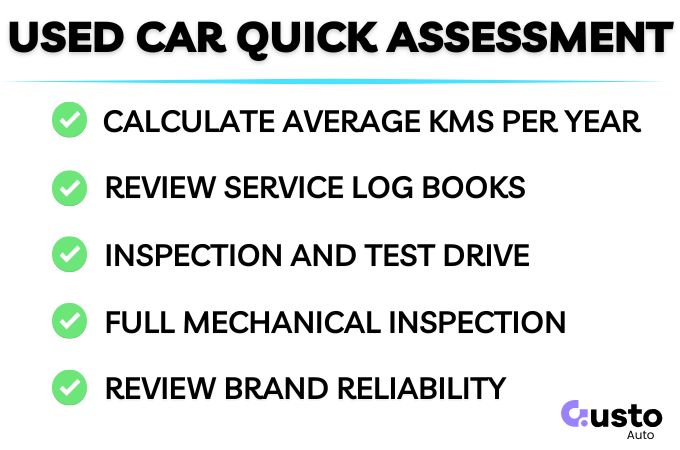
Calculate the Car’s Annual Driving Average
An odometer reading is meaningless without context. To understand a car’s real usage history, calculate its annual average with this formula:
Total Kilometres ÷ Vehicle Age in Years = Average KM Per Year
Compare this figure against the typical Australian driving average of 12,000–15,000 km per year.
The result tells a story:
- Too high: A number far above the benchmark suggests heavy use, possibly as a rideshare car or courier van. Expect higher wear on the engine, driveline, and suspension.
- Too low: An unusually low figure can mean the car sat idle for long periods, causing seals to dry out. It could also indicate a life of short trips, which are harsh on an engine.
The type of driving matters, too. 20,000 highway kilometres can be gentler on a car than 10,000 kilometres of stop-start city traffic.
Use this number not as a final verdict, but as a powerful question to ask the seller about the car’s history.
Verify the Logbook
A logbook full of stamps looks reassuring but reveals little.
A good service history includes itemised invoices from a consistent workshop, proving work was done at regular intervals.
On high-kilometre cars, this is your only proof that expensive, scheduled jobs like a timing belt replacement were completed.
A failed belt can destroy an engine, costing thousands.
Be wary of red flags that signal neglect or dishonesty:
- Long service gaps: Years of missed maintenance suggest potential internal wear.
- Sudden pre-sale work: A flurry of repairs can mean the owner is fixing just enough to sell a problem car.
- Mismatched records: Dates or kilometre readings that don’t line up are a clear warning.
If the history is incomplete, assume expensive catch-up maintenance is needed. Use this missing information as a powerful tool to negotiate a lower price.
Budget for Future Repairs, Not Just Past Service History
A complete logbook proves past care, but it doesn’t erase future costs.
Smart buyers budget for the high-kilometre services that are statistically due, turning unknowns into predictable expenses.
Before making an offer, factor in these common cost areas:
- Major Service Items: A timing belt replacement ($800–$2,000+) is a non-negotiable expense if due. Cars with a timing chain avoid this specific cost, but chain issues are often far more expensive to fix.
- Cooling System: Budget for ageing hoses and thermostats. The water pump is often replaced with the timing belt as a preventative “while you’re in there” job to save on future labour costs.
- Suspension & Steering: Worn bushes, shocks, and steering components are common after 150,000 km. A suspension refresh can easily cost over $1,500.
- Tyres & Brakes: Often a near-term cost on any used car purchase.
Neglecting one repair often creates another.
A leaking water pump ignored during a timing belt service can cause the new belt to fail, leading to catastrophic engine damage.
If a major service is due, treat its cost as a direct deduction from the asking price.
It’s not a future problem; it’s a current liability.
Always get quotes for your specific make and model from a trusted mechanic before committing to the car or the car finance.
Run This 30-Minute DIY Inspection Before Making an Offer
Before paying a mechanic, use this 30-minute checklist to spot obvious deal-breakers.
It requires 10 minutes for stationary checks and 20 minutes for a test drive.
- Paperwork: Match the VIN on the car to registration papers. Confirm the seller has a consistent service history and a clear PPSR check showing no money is owing.
- Walk-around: Look for uneven tyre wear, mismatched paint between panels, and rust bubbles around wheel arches or under doors.
- Engine: Check for visible oil leaks and look for milky residue on the oil cap. Inside, turn the ignition on to see all warning lights activate, then extinguish.
- Interior: Test the air conditioning, windows, and locks.
- Test Drive: Listen for odd noises on a cold start. Feel for smooth gear changes, steering vibrations at speed, and confirm the car brakes in a straight line without pulling.
If this DIY check reveals any red flags, high kilometres, or a patchy history, a professional inspection is non-negotiable.
The fee is cheap insurance against a potential $3,000 engine repair.
Decode the Real Wear on Utes and 4x4s
For utes and 4x4s, kilometres are a misleading measure of wear & tear.
A vehicle used for heavy towing or constant off-roading endures far more stress than one covering the same distance on a highway.
Instead, look for physical signs of a hard life the odometer cannot show:
- Towing abuse: Check for a worn tow hitch, makeshift trailer wiring, and sagging rear suspension. The service history must show frequent transmission and differential oil changes.
- Off-road damage: Inspect the underbody for deep scrapes, bent bash plates, and caked mud in chassis rails. Aftermarket suspension lifts also suggest harder use.
- Corrosion: Look for rust under carpets and around wheel arches, especially on vehicles from coastal areas. Serious rust is a non-negotiable deal-breaker.
The cheapest high-kilometre work vehicle is often the most expensive to own.
(Optional) Assess a Brand’s Reliability
If you really want to go down a rabbit hole then you can spend some time researching the long term reliability of the manufacturer and their models.
Some brands are known for long-term reliability and cheaper parts, but it’s smarter to assess a specific model’s risk profile rather than relying on brand stereotypes.
To do this, investigate four key areas:
- Parts Cost: How expensive and available are common replacement parts?
- Specialist Labour: Does the car require specialist mechanics for routine servicing?
- Common Failures: What are the model’s most frequent big-ticket repair items?
- Owner Forums: Are there active communities sharing known issues and fixes?
A well-serviced European car can be reliable, while a neglected “safe bet” like a Toyota or Mazda can become a maintenance nightmare.
Before you buy, research the model’s known issues online.
This approach helps you follow the most important rule: buy the car you can afford to maintain, not just purchase.
Frequently Asked Questions
Is 200,000 km automatically too many for a used car?
No, 200,000 km should not disqualify a used car on its own. You should also consider the vehicle type, service history, and the kind of driving it has done. A well-maintained diesel ute that has covered mostly highway kilometres can be a better buy than a 150,000 km city car with a patchy logbook.
What is a good kilometre range for a 5-year-old car?
A good range for a 5-year-old car is typically between 60,000 and 75,000 km, based on the Australian average of 12,000–15,000 km per year. Significantly more could indicate heavy use as a commercial vehicle, while very low mileage might suggest a life of short, engine-wearing trips.
Is a diesel engine better at high kilometres?
Diesel engines are often more durable and built for higher mileage, but this is only true if they have been meticulously maintained. They can also be more expensive to repair if something goes wrong.
Can I still get finance on a high-kilometre used car?
Yes, you can often get finance for a high-kilometre car, but some lenders will have strict caps in place which could limit your options. However, there are non-bank lenders who will consider vehicles up to 300,000 kms.
Should I skip a pre-purchase inspection to save money?
No, skipping an inspection on a high-kilometre car is a false economy. The few hundred dollars you save is insignificant compared to a potential $3,000 engine or transmission repair bill.
Your High-Kilometre Used Car Checklist
You can use this basic framework to separate genuine bargains from expensive mistakes.
- Filter by kilometre bands: Use the 100k, 150k, and 200k+ ranges as a starting point to gauge risk, not to make a final decision.
- Analyse the annual average: A car’s km/year figure reveals its history. Was it a highway cruiser or a city workhorse?
- Demand proof: A complete service history with invoices for major jobs is your best defence against hidden mechanical issues.
- Budget for what’s next: Factor in the cost of upcoming major services and a professional inspection when you negotiate.
Before you start, getting pre-approved for used car finance is the smartest move.
It tells you exactly what age and kilometre limits lenders will accept for your profile, whether you have a perfect credit score, are rebuilding your credit, or are self-employed.
Speak to one of our specialist brokers to match you with a lender comfortable financing high-kilometre vehicles, saving you from failed applications and protecting your credit score.

