
Purchasing a vehicle directly from the owner offers the chance to save on the purchase price, but it comes with zero safety net.
You trade the consumer protections of a licensed dealership for a lower price, but take on significantly more responsibility.
If you are weighing up the Pros & Cons of Buying a car privately, this guide details the specific risks and administrative hurdles you must manage.
We will cover the essential checks, payment processes, and paperwork required to ensure a safe handover.
Pros of a Private Car Sale
Potential Savings
Private sales remove the middleman, often saving you 10-20% compared to dealership prices.
You avoid paying for showroom overheads, sales commissions, and the reconditioning fees baked into dealer stock.
You also gain a negotiation edge because some private sellers often value speed over maximum profit.
If they just want a fast, low-stress exit, you are well placed to get a better deal.
Use these practical steps to negotiate effectively:
- Show the seller comparable listings with similar kilometres and trim to prove your offer is fair.
- Use issues like worn tyres or scratches found during the test drive to justify a specific price reduction.
- Show up with a deposit ready and finance pre-approval to win against other buyers.
However, a low price is not a guarantee of quality. Never let a discount distract you from completing a PPSR check and a proper mechanical inspection.
Unlimited Choice and a Fast Purchase
Dealerships limit you to their current stock, unless they offer a custom buying service.
Buying privately opens the entire market so you can find the exact make, model, and specs you want.
Speed of Transaction
If prepared, the transaction you can buy on the spot.
You can inspect the car, negotiate the price, and agree on handover terms in a single meeting, but should only do so if you have some car knowledge.
In most cases, a mechanical inspection is a smart move prior to committing to the purchase. But this will take time.
Cons of Buying a Car from a Private Seller
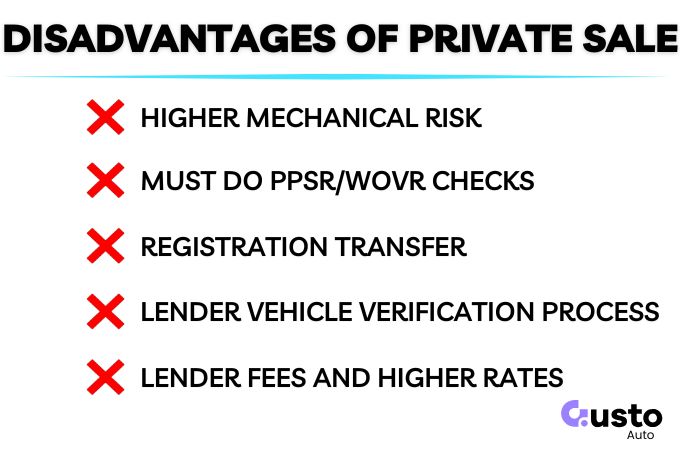
Higher Mechanical Risk
Private sales are strictly buyer beware.
Unlike purchasing from a licensed dealer, there is no statutory warranty or cooling-off period to protect you.
Once money changes hands, the car is your problem.
If the engine light turns on during the drive home, you cannot demand a refund or repair.
Disputes are notoriously difficult to resolve because you are negotiating with an individual, not a regulated business process.
The lack of consumer protection hits these buyers hardest:
- Older Vehicles: High-kilometer cars are statistically more likely to suffer immediate mechanical failure.
- Tight Budgets: If you stretch your finances to buy the car, a surprise repair bill becomes a financial disaster.
- Work Vehicles: If you rely on the car for income, you cannot afford the downtime of a breakdown.
You may need to retain a cash buffer in case of emergency repairs when considering your budget.
You should also never finalise a private sale without a comprehensive independent mechanical inspection.
This adds additional cost and takes time.
You are Responsible for Checks
It is the buyer’s responsibility to confirm the vehicle’s history, condition, and if it is free of an encumbrance.
Conduct a search on the Personal Property Securities Register (PPSR) to see if there is any existing security over the vehicle.
The search costs a few dollars and should be done before all sales.
In the same search you will also get information on the Written Off Vehicle Register (WOVR).
This tells you if the vehicle has previously been involved in a serious accident.
You also need to check the existing registration, and/or loan paperwork to be sure the seller is the legal owner of the vehicle.
Administrative Burden
When buying privately you will have to coordinate with the seller to ensure the registration is transferred to you in a timely manner.
A notice of disposal should be completed by the seller within a set deadline. But you will need to follow up to ensure this is done.
Compared to a dealership sale where the majority of the paperwork is done for you, this can be an additional time commitment.
More Difficult (and Costly) to Finance
Lenders often add an additional setup fee when establishing a car loan on a private sale due to the extra administrative work involved.
In some cases, they also charge a higher interest rate depending on the lender.
Before securing approval, there may be additional work required to help the lender assess the vehicle as viable security.
This usually involves using software as directed by the lender to facilitate these checks.
This can slow things down and frustrate the seller of the vehicle. Especially when asking for their personal information.
For example, you may be required to provide:
- Make, model, and year
- VIN
- Seller’s ID
- PPSR checks done in platform
- Multiple photos of vehicle
Payment Risk
You will need to balance the timing of the payment to the seller to ensure that you can take possession of the vehicle simultaneously.
This is now much easier with things like PayID or Osko able to process instant payments, but be weary of transaction limits in your account.
A bank may also enforce a 24-hour hold on payments to new payees, which can delay things further.
Ideally you write out the agreement on paper prior to making payment and taking possession of the vehicle. This should include:
- Date, time, sale price, VIN, and registration number.
- Full names and signatures of buyer and seller.
- All inclusions (spare keys, logbooks, accessories).
Frequently Asked Questions
How do I safely pay for a private car without getting scammed?
First, You must confirm they are the registered owner of the vehicle. When making payment you also should be present and able to take possession of the vehicle immediately. An instant bank transfer through PayID or OSKO can be helpful, but limits are usually too low for a car purchase. A regular online bank transfer can make up the difference, or a transaction completed in a branch.
What documents should I get at the handover?
You must receive a signed bill of sale or receipt that lists the VIN, sale price, date, time, and full names of both parties. Ensure you also collect the current registration papers, service logbooks, spare keys, and any inspection reports.
Does a private seller need a roadworthy or safety certificate?
No, the seller has no obligation to provide a roadworthy certificate. Only a licensed dealership must do so. It is up to the buyer to perform any mechanical inspections prior to purchase.
Can I get finance for a private sale?
Yes, although some lenders view private sales as higher risk and may require additional vehicle inspections. You should seek pre-approval prior to committing to a private purchase.
Summary
Private sales offer lower prices but shift all risk to the buyer.
You have zero statutory protection and places the responsibility for a clean PPSR check, independent mechanical inspection, and insurance on the buyer.
If you can’t verify the ownership, current registration, and vehicle history, then you should not buy it.
If you need help navigating the strict finance criteria on a private sale then get in touch with out team of brokers today.

